Asset Store
Discover high-quality assets for your next game project, or create your own with AI.
Create AssetDiscover high-quality assets for your next game project, or create your own with AI.
Create Asset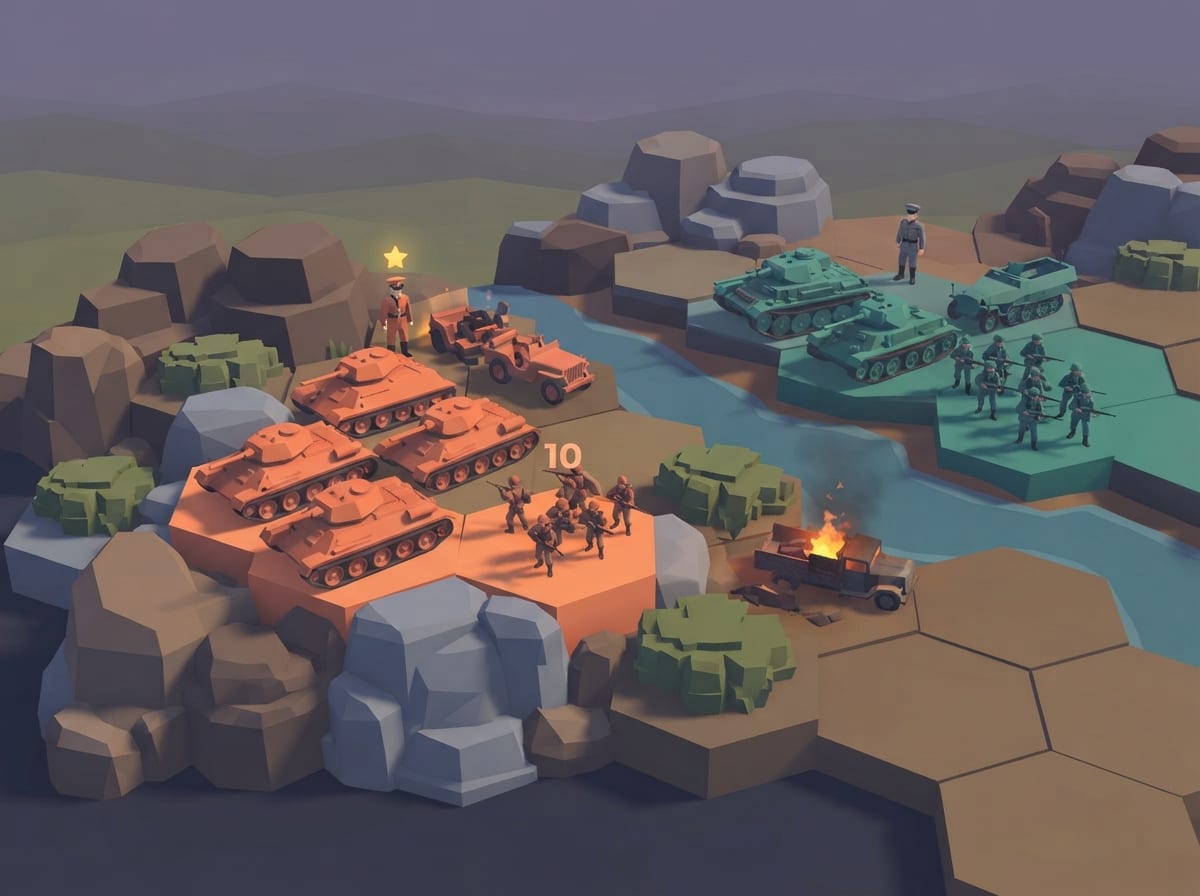
Made with Nano Banana 2 Lite · CC0 · 7 Oct 2026
Generated from: a scene from a small video game about: Design and implement a turn-based military strategy game whose fundamental design DNA, pacing, strategic structure, tactical combat, progression systems, audiovisual personality, replayability, and moment-to-moment satisfaction are modeled extremely closely on **Heroes of Might and Magic III**, while adding a deep **multi-age technological progression system inspired by the best aspects of Rise of Nations**. The player begins with relatively early military technology and, over the course of a long game, gradually advances through multiple technological and doctrinal ages until reaching contemporary and eventually plausible near-future warfare. The critical distinction is that this progression must be **slow, consequential, and deep**. An age must not feel like a ten-minute waiting room before better units unlock. Players should spend enough time within each age to: - understand its unit matchups, - master its tactical possibilities, - learn its economic priorities, - exploit its commander specializations, - discover strong army compositions, - recognize faction differences, - develop infrastructure, - fight meaningful wars, - become comfortable with the current military paradigm, and only then begin transitioning into the next age. The experience should repeatedly produce the feeling: > “I finally understand how warfare works in this era—and now new technology has appeared that changes some of the rules.” The goal is not to copy Heroes III's copyrighted characters, fantasy creatures, names, art, music, lore, maps, or visual assets. Instead, reverse-engineer why Heroes III is so enduringly compelling and reproduce those mechanics and interactions within an evolving military-history framework. The player should be able to sit down intending to play for twenty minutes and realize hours later that they kept wanting to explore one more location, capture one more resource site, recruit one more unit, finish one more base upgrade, unlock one more technology, reach the next age, level one more commander, or fight one more battle. # Core design philosophy Do **not** turn this into an RTS, grand-strategy spreadsheet, city builder, traditional 4X game, or hyper-detailed military simulation. The foundation must remain unmistakably Heroes III: - Turn-based strategic adventure map. - Individual commanders move armies around the map. - A limited pool of movement points replenishes every day. - Exploration constantly reveals small opportunities and decisions. - Armies consist of a small number of **unit stacks** rather than hundreds of individually controlled troops. - Battles take place on a separate compact hex-based tactical battlefield. - Bases generate units and resources. - Normally only one major construction project can be completed at a base per day. - Unit availability replenishes on a predictable weekly rhythm. - Commanders gain experience, levels, primary attributes, secondary skills, equipment and special abilities. - Capturable resource-production sites make territorial expansion immediately rewarding. - Neutral forces guard desirable locations. - The world is filled with optional encounters, upgrades, caches, training locations and unusual one-off opportunities. - Powerful locations tempt the player before they are strong enough to safely capture them. - Strong armies create a satisfying transition from vulnerability to dominance. - Different commanders and factions encourage meaningfully different strategies. - Losing a battle can be catastrophic enough that entering combat matters. - The map gradually changes from mysterious and threatening to understood and controlled. - Strategic movement, army composition and economic growth matter at least as much as tactical combat. Layer on top of this a long-term technological arc: **Explore → Assess → Commit → Grow → Master an Age → Transform → Rediscover the Strategic Landscape** Advancing an age should renew the player's curiosity instead of simply increasing numbers. # The Age System The game should have approximately **6 major technological ages**, configurable by scenario. A strong default progression could be: ### Age I — Mechanized Warfare Approximately late-WWII / immediate postwar technological capability. ### Age II — Jet & Missile Age Early Cold War military transformation. ### Age III — Combined Arms Age Mature Cold War mechanized warfare. ### Age IV — Precision Warfare Age Late Cold War through Gulf War-style technological transition. ### Age V — Networked Warfare Age Contemporary digitally connected military forces. ### Age VI — Autonomous Warfare Age Plausible near-future military technology grounded in systems already emerging today. Do not obsess over exact historical dates. Each age represents a **military paradigm**, not merely a calendar period. The progression should feel historically recognizable while allowing fictional factions to develop differently. # Ages must progress slowly This is extremely important. Do not allow players to rush through six ages in an hour. In a normal long scenario, an age should often constitute a substantial chapter of the game. Depending on map size and game settings, a player might spend: - several game weeks developing within an age, - multiple major battles using its technology, - substantial resources building its infrastructure, - several commander levels mastering its doctrines, before advancing. The player should have enough time to form opinions like: > “In the Combined Arms Age, this faction's medium armor and artillery combination is extremely strong.” or: > “During the Precision Warfare Age, I need to protect my SAM units because otherwise air support destroys my artillery.” That knowledge should have time to matter. A game should not feel like: > obsolete unit → research button → slightly better obsolete unit → research button. Instead, each age should feel almost like a miniature strategy game nested inside the larger campaign. # Advancing to a new age Age advancement should require a meaningful strategic investment. Do not use only a passive research timer. Require some combination of: - resources, - research infrastructure, - base development, - specialized strategic resources, - commander or faction achievements, - control of particular infrastructure, - completion of important technologies. For example: To advance from the Combined Arms Age to the Precision Warfare Age, a faction might need: - an Advanced Command Center, - a Research Complex, - sufficient Electronics, - sufficient Credits, - several prerequisite technologies. Advancement should compete with immediate military spending. The player should frequently face: > “Do I spend these electronics and credits modernizing my army now, or save them to enter the next age?” That is a valuable strategic tension. # Age advancement must not be automatic Different players can occupy different ages simultaneously. This is essential. One faction may invest aggressively in technology while another invests in a massive army. That can produce situations such as: - technologically advanced but numerically weak army, - older but enormous veteran army, - rich faction preparing rapid modernization, - territory-heavy faction lagging technologically, - smaller faction attempting to leapfrog competitors. A faction one age behind should be disadvantaged, but not automatically doomed. Skill, veterancy, numbers, commanders, terrain and logistics should remain capable of defeating superior technology. # Technological transitions should change warfare The purpose of ages is **not** simply: Tank I → Tank II → Tank III → Tank IV. Each age should introduce technologies that change strategic assumptions. For example: ## Mechanized Warfare Age Dominant concepts: - mass infantry, - artillery, - early mechanized forces, - limited battlefield reconnaissance, - short-range air support, - strong defensive positions, - relatively limited precision., as an in-game screenshot in chunky low-poly 3D with flat shaded materials. Palette: dusk violet #2b2d42, stone #8d99ae, player coral #ef8354, threat teal #2a9d8f, accent gold #f4d35e. Everything is original: never draw or resemble characters, places or logos from existing games, films or brands (no red-capped plumbers, no famous mascots), even when the idea names one. Keep the pictures honest: they promise what a small first version of this game, made in a game engine in a few days, can look like. Simple readable shapes, clear silhouettes, few flat materials, the in-game camera view. Never film stills, photoreal renders, AAA key art, detailed textures, cinematic lighting, or anything that looks like a big-studio game. No text, UI, HUD, logos or editor screens inside any image.
Creator
Will Adams-Keane
Sign in to join the conversation.
Sign in to comment🌍CC0
Use, share, and remix the model freely with no restrictions and no attribution needed.