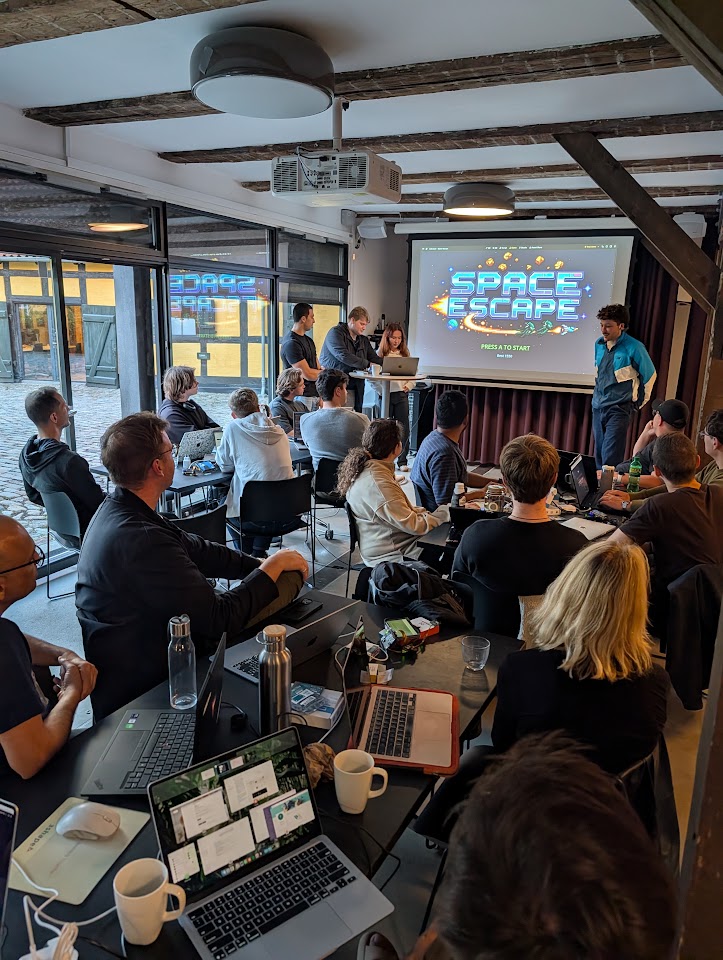
Space Escape · Sharing a game with the room at the Copenhagen hackathon.
01
Build with your players.
You do not have to wait until a game feels enormous or finished to learn whether its central idea is fun. A small, playable version can give you something much more useful: people actually playing it.
Share it with friends. Watch what they understand, what surprises them and where they get stuck. Take the feedback that helps your game, make the next version and let them try again. We want that loop to be a natural part of making a game.
02
Make it in Summer Engine. Share it through Summer Games.
Summer Engine is your place to build: code, scenes, assets and the tools your agent works with. Summer Games is the player destination: a place to discover games and get into the experience you made.
The public website lets people explore what is there. Playing uses the Summer Games desktop app; browsing a game page is not the same as running the game in a browser. That distinction should be clear when you invite someone to play.
03
Give people something they can understand before they download.
A title and a screenshot should start telling the story. Explain what someone does in the game, what kind of experience it is and whether they will be playing alone or together. Real gameplay helps people recognize whether it is for them.
Also explain the things that affect their decision: supported platforms, the game’s content and audience, purchases if there are any, and how the game was made. Credit the people whose work is part of it.
The release path connects your project to something players can install. Test the game locally, prepare the export for your release target and follow the upload and submission process.
An uploaded file is not automatically a published game. The guides explain the steps and requirements for each stage, so you and your agent can work through the actual process.
Once people are playing, you get to see what matters outside your own test session. A feature you thought was small might become everyone’s favorite part. Something that seemed obvious might need to change.
Keep the relationship close: listen, decide what fits the game and share an improved version. Updates are part of building with a community. You still choose the direction of the game.
Multiplayer, purchases and mods are choices you can make.
If playing together is central to your idea, Summer’s multiplayer infrastructure and agent-readable SDK help you build it. If optional purchases fit, explore Sparks and the creator program. If you want players to build on your work, choose whether to allow mods.
You do not need every part of the ecosystem for every game. Pick the parts that serve the experience you want to make.
We want Summer to be an easy, useful place to launch and improve a game. We want you to stay because the platform and the people here help your game grow.
You own your game and can launch it elsewhere. Prepare the build for that destination and understand the services it relies on. Choosing Summer Games does not take that decision away from you.