I Have a Game Idea. Now What?
You had an amazing game idea. Here's how to turn it into a real, playable game. A practical guide from first spark to working prototype.
By Summer Team
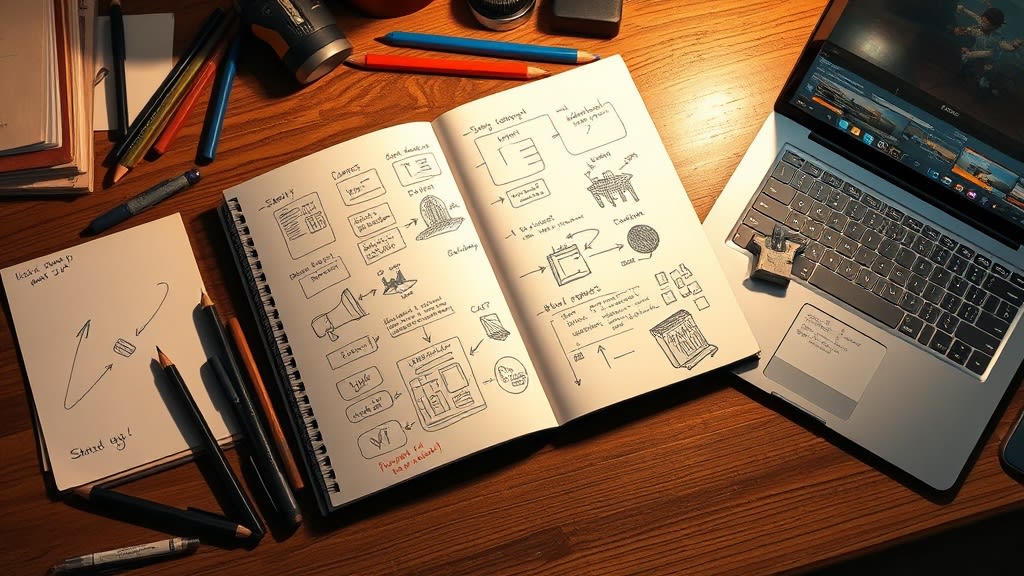
You have a game idea. It hit you at 2am and now you can't sleep. Maybe it's an RPG with a twist nobody's seen before. Maybe it's a puzzle mechanic that would blow people's minds. Maybe it's "Stardew Valley but in space." Whatever it is, it feels real. It feels important. You're lying there thinking this could actually be something.
Here's the thing: you're right. It could be something. But ideas don't become games on their own. They become games through a series of small, concrete steps. And the first step is much simpler than you think.
Write It Down (Seriously)
Tomorrow morning, before the excitement fades, open a notes app and write one paragraph. Not a design document. Not a wiki. One paragraph.
Answer these three questions: What does the player do? What makes it fun? Why would someone play this instead of watching TV?
That's it. If you can't describe your game in one paragraph, you don't have a game idea yet. You have a feeling. Feelings are great starting points, but they need to be compressed into something concrete before they can become anything real.
Here's an example: "The player runs a repair shop for broken robots. Each robot arrives with a unique personality glitch. You diagnose the problem through conversation, then physically rewire their circuits in a puzzle minigame. It's fun because every robot is different, the dialogue is funny, and the puzzles get harder as you unlock new tools."
That's a game. You can build that. You can picture someone playing it.
Find the Core Loop
Every game that works has a loop. The player does a thing, gets a reward, then does a harder version of the thing. Over and over. That's what makes games feel good.
Platformer: run, jump, reach the goal. RPG: explore, fight, level up. Farming sim: plant, harvest, sell, expand. Roguelike: attempt a run, die, unlock something, try again.
What's your loop? Write it down in one line. "The player does X, which leads to Y, which makes them want to do X again." If you can't find the loop, your idea might be a story, or a world, or a vibe. Those are valuable, but they need a loop wrapped around them to become a game.
Don't overthink this. The loop can change later. But having one early gives you something to test.
Build the Worst Version First
This is the step where most people stall. They think they need to learn an engine for six months, watch a hundred tutorials, and master 3D modeling before they can start. They don't.
You need to build the worst possible version of your game. Not a prototype. The worst version. One room. One mechanic. Placeholder art. No menus. No title screen. No polish.
If your game is about repairing robots, build one robot with one puzzle. If it's a platformer, build one level with one jump. If it's a farming sim, build one crop cycle.
The reason this works is brutal and honest: if the worst version is fun, you have something worth building. If the worst version is boring, no amount of art, music, or content will save it. The core has to work. You want to find that out in a weekend, not after a year of development.
Tools for Turning Ideas Into Games
The traditional path looks like this: pick an engine (Unity, Godot, Unreal), spend weeks learning the interface, follow tutorials, write code, debug, iterate. Eventually, maybe months later, you have something that moves on screen. It works. Millions of great games were made this way. But it is slow, and most people quit before they get to the fun part.
With Summer Engine, you describe your game idea in a conversation. "I want a top-down game where the player controls a little robot in a repair shop." The engine builds it. You play it. You say "make the robot move faster" or "add a workbench the player can interact with." You iterate in minutes, not months.
This isn't magic and it won't build your entire game for you. But it collapses the distance between having an idea and seeing it on screen. That matters more than people realize. Because the moment you can play your idea, you start learning what works and what doesn't. And that learning is where real game design happens.
The Ideas That Work vs. The Ideas That Don't
Let's talk about the trap. You know the one. "It's an open-world MMO RPG with full crafting, base building, 200 hours of story content, multiplayer co-op, and procedurally generated dungeons."
That's not a game idea. That's a feature list. And feature lists don't ship.
The ideas that actually become real games start small. Absurdly small. Undertale started as a battle system. Stardew Valley started as one farm. Hollow Knight started as one character in one room with one attack.
Start with one room. One mechanic. One minute of gameplay. If that one minute is interesting, you can build outward from there. If it's not, you can throw it away and try a different minute. Both outcomes are progress.
The biggest trap in game development isn't lack of skill. It's scope. The gap between "what I imagine" and "what I can build" has killed more games than any technical limitation.
What to Do After the Prototype
You built the worst version. It's ugly and janky and held together with duct tape. But something about it is fun. Now what?
Put it in front of someone. A friend, a family member, someone in an online community. Watch them play. Don't explain anything. The places where they get confused are the places your design is unclear. The places where they smile are the places your design is working.
Then iterate. Fix the confusing parts. Expand the parts that work. Add a second level, a second mechanic, a second minute of gameplay. Layer in art when the design feels solid. Add sound. Add music. Polish.
This loop of build, test, learn, repeat is the entire craft of game development. Every studio in the world, from solo indie devs to thousand-person AAA teams, follows some version of it. You are not behind. You are at the beginning, which is exactly where everyone starts.
Your Idea Is Worth Building
The difference between people who make games and people who just think about making games is not talent. It's not money. It's not connections. It's whether they took the idea out of their head and put it somewhere real.
Write it down. Find the loop. Build the worst version. Test it. Improve it. Ship it.
Your 2am idea is waiting.
Turn your idea into a playable game today, or read the practical guide to making a game with AI in 2026. Browse starter templates to see what's possible.
Keep reading
All posts- Jun 6, 2026 · 7 min readAI Game Concept Generator: How to Go From Prompt to PlayableWhat an AI game concept generator actually does, how to write a concept you can build, and how to turn that concept into a real, playable game. Honest free vs paid breakdown.

- Jun 6, 2026 · 7 min readAI Enemy Generator for Games: What It Is and How to Use One (2026)What an AI enemy generator actually does, the three layers it should cover (sprite, stats, behavior), and how to build working enemies for your game by describing them in plain language.

- Jun 6, 2026 · 8 min readAI Horror Game Maker: How to Build a Horror Game by Describing It (2026)How to build a real horror game with AI: the five mechanics that actually make a game scary, which template to start from, and a step by step workflow inside Summer Engine where the AI is wired into the editor.
