15 Games Like Minecraft for Building, Surviving, and Exploring
The best games like Minecraft in 2026. From Terraria to Valheim to Subnautica, these are the sandbox survival games worth playing next.
By Summer Team
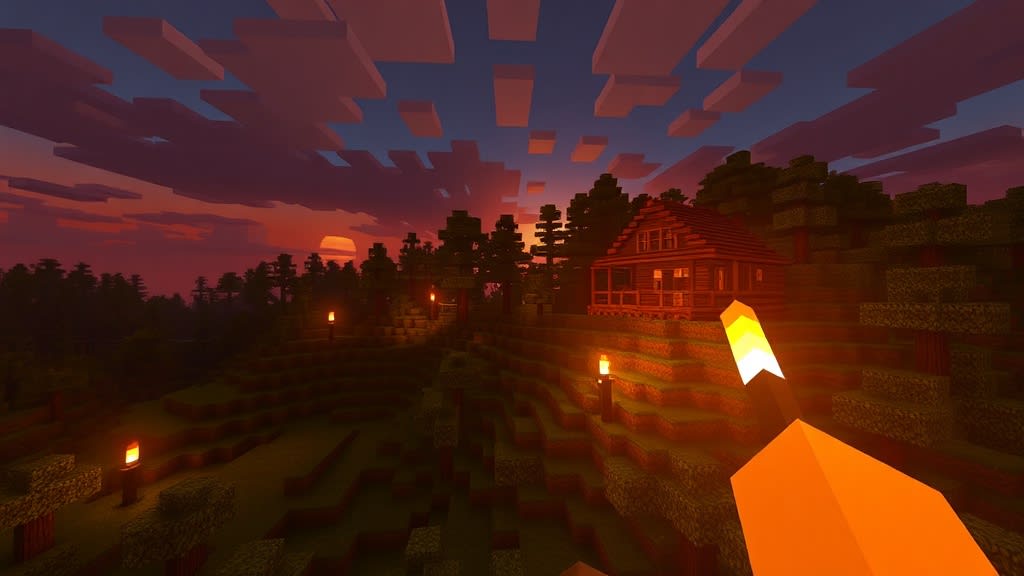
Minecraft works because it trusts the player. No mission marker telling you where to go. No cutscene explaining why you should care. You spawn in a procedurally generated world with nothing, and within minutes you understand the deal: punch trees, make tools, build shelter before dark. That loop -- gather, craft, build, explore -- sounds almost too simple to hold anyone's attention for long. And yet hundreds of millions of people have sunk thousands of hours into it.
The reason is layered depth beneath apparent simplicity. Redstone circuits let engineers build functioning computers inside the game. The building system is flexible enough that people have recreated entire cities block by block. The survival mechanics create genuine tension on your first few nights, and the progression from dirt hut to nether fortress feels earned every time. Minecraft is not one game. It is a creative tool, a survival challenge, and a canvas for whatever you want it to be.
That is also why finding something "like Minecraft" is tricky. No single game replicates the whole package. But plenty of games take one of its core pillars and push it further. This list covers fifteen of them, grouped by the itch they scratch. If you know which part of Minecraft you love most, skip to that section.
Building and Creativity
These games put construction and creative expression front and center. Combat and survival take a back seat (or disappear entirely) so you can focus on making something impressive.
1. Satisfactory
Platforms: PC, PlayStation 5
Satisfactory is what happens when you take the redstone-obsessed corner of the Minecraft community and build an entire game around their specific brand of madness. You land on an alien planet as an engineer for FICSIT Incorporated, and your job is to automate production chains until every square meter of wilderness is covered in conveyor belts, splitters, and smelters.
The building is first-person and freeform. You snap foundations together, stack factories vertically, route belts through walls, and connect everything to a power grid you also have to design. The satisfaction (the name knows what it is doing) comes from watching early-game spaghetti belts evolve into a clean, optimized megafactory. There is always one more bottleneck to fix.
Where Minecraft's building is block-by-block and improvisational, Satisfactory rewards planning and systems thinking. You are not placing individual blocks so much as designing industrial infrastructure. If you have ever spent an evening building a sorting system in Minecraft and thought "I wish the whole game was this," Satisfactory is your answer.
2. Dragon Quest Builders 2
Platforms: PC, PlayStation, Nintendo Switch
Dragon Quest Builders 2 solves the existential crisis that hits every sandbox player eventually: "Why am I building this?" In pure sandbox games, you build for yourself. Here, you build for a world that reacts. Construct a kitchen and your villagers start cooking. Build bedrooms and they sleep in them. Plant farms and they harvest crops. The feedback loop between creation and consequence makes every building project feel meaningful.
The JRPG structure gives you direction without strangling your creativity. Each island presents a scenario -- a farming community that needs rebuilding, a mining town under threat -- and you solve it through construction. But the game never tells you exactly what to build or where. The blueprints are suggestions, not mandates. Once you unlock the Isle of Awakening, all restrictions come off and you have a massive sandbox to fill however you want.
The block-based building will feel immediately familiar to Minecraft players, but the combat, story, and NPC systems add layers that Minecraft intentionally leaves out. Sometimes you want a reason to build beyond "because I can."
3. Lego Worlds
Platforms: PC, PlayStation, Xbox, Nintendo Switch
An open-world sandbox where everything is Lego bricks. You explore procedurally generated biomes, discover new brick types and prefab structures, and build whatever you can imagine using the same interlocking system you played with as a kid. The Discovery Tool lets you scan any object in the world -- a castle, a dragon, a pirate ship -- and add it to your permanent collection for instant placement later.
The terrain tools diverge from Minecraft significantly. Instead of placing blocks one at a time, you paint landscapes, raise mountains, and carve valleys with broad strokes. Large-scale construction is faster but less precise than Minecraft's grid.
Lego Worlds lacks the survival pressure and progression depth of Minecraft, and performance can struggle when builds get massive. But as a pure creative sandbox, especially for younger players or families, it hits a sweet spot that nothing else reaches. The Lego license is not just a skin -- the snap-together building genuinely feels different from placing cubes.
4. Astroneer
Platforms: PC, PlayStation, Xbox, Nintendo Switch
The most relaxed game on this list by a significant margin. Astroneer drops you on a colorful alien planet with a terrain-deforming tool that feels like sculpting clay. You gather resources, research technology, build bases, and eventually launch to other planets in your solar system. There is no combat. Nothing is trying to kill you except your own poor oxygen management.
The terrain tool is the standout mechanic. You can literally reshape the planet: tunnel through mountains, flatten plains for your base, dig straight down to the planet's core. It gives construction a sculptural quality that grid-based building cannot match. Bases snap together from modular components -- platforms, research stations, smelters -- connected by cables and powered by solar panels, wind turbines, or generators.
Progression is exploration-driven. Each planet has unique resources needed for higher-tier technology. Getting to a new planet requires building a shuttle and a solid oxygen supply, which requires resources from your current planet, which requires exploration and base expansion. The loop is gentle but persistent. Astroneer is Minecraft with the volume turned down -- same core verbs, much lower stakes, equally engaging.
Survival and Challenge
If you love Minecraft for the tension of your first night, the resource scarcity, and the satisfaction of overcoming a hostile world, these games turn that dial up considerably.
5. Valheim
Platforms: PC, Xbox
Viking survival that nails the fantasy of taming a hostile wilderness with nothing but your hands and whatever you can scavenge. You wake up in a procedurally generated purgatory and must defeat five forsaken bosses to prove your worth to Odin. The progression is biome-gated: each new area introduces tougher enemies, new resources, and harsher environmental hazards.
The building system is physics-based and surprisingly deep. Structures need proper support or they collapse. Wood rots in rain unless you build a roof. Smoke from your fire needs ventilation or it will suffocate you indoors. These constraints force thoughtful architecture instead of gravity-defying block towers. The result is that player-built bases in Valheim tend to look genuinely impressive because the physics demand structural integrity.
The co-op is where Valheim truly excels. Sailing across the ocean to a new continent, building a forward base, gearing up, and taking down a boss as a group is one of the best cooperative experiences in any survival game. The art style is intentionally low-resolution and it looks stunning anyway.
6. The Forest
Platforms: PC, PlayStation
You survive a plane crash on a forested peninsula. Your son is kidnapped. The locals are cannibals. The Forest takes the survival crafting formula and injects genuine horror, and the blend works far better than it has any right to. During the day you chop trees, build shelters, and set traps. At night, mutants come. The AI is what sets it apart -- enemies scout your base, test your defenses, and adapt their approach. They are not just damage sponges walking toward you.
The building is freeform with a blueprint system. You place a blueprint, then fill it with resources. Walls, floors, custom structures, treehouses, houseboats. The cave systems underneath the peninsula are some of the most atmospheric underground environments in any game, and exploring them is both terrifying and essential for progression.
Its sequel, Sons of the Forest, expanded the scope with better graphics, a larger map, and companion NPCs. But the original remains a tighter, more focused experience. Play it first, ideally with one or two friends who do not mind being genuinely startled.
7. Vintage Story
Platforms: PC
If you have ever wished Minecraft took itself more seriously, Vintage Story is the game you did not know existed. Born from a Minecraft mod, it is now a standalone title that keeps the voxel foundation but layers on simulation depth that borders on obsessive. Seasons change and affect crop growth. Metal progression requires actual knowledge of smelting -- you need the right clay mold, the right fuel, the right temperature. Temporal storms roll in periodically and spawn horrors that will shred an unprepared player.
The survival mechanics have real teeth. Food spoils. Wolves hunt in packs. Winter can kill you if you have not prepared. The first time you successfully smelt copper after hours of learning the system, it feels like a genuine achievement rather than a recipe you looked up on a wiki. The world generation creates varied terrain with geological layers, and mining feels purposeful because ore placement follows logical rules.
The community is small but deeply invested, and the development team ships frequent, substantial updates. Vintage Story is not for everyone -- the learning curve is steep and the pace is deliberate. But for players who bounced off Minecraft because it felt too easy or too shallow in its survival systems, this is the definitive answer.
8. Grounded
Platforms: PC, Xbox
Honey, I Shrunk the Kids as a survival game, developed by Obsidian Entertainment. You are a teenager miniaturized to the size of an ant in a suburban backyard, and suddenly every blade of grass is a building material, every juice box is a landmark, and every spider is a boss fight. The scale shift recontextualizes survival crafting in a way that feels genuinely fresh even if you have played dozens of games in the genre.
The insect AI is surprisingly sophisticated. Ants are neutral until provoked, living in colonies with patrol routes and resource-gathering behavior. Wolf spiders are apex predators that will hunt you across the yard. The ecosystem creates emergent encounters -- you might stumble into a battle between ants and a bombardier beetle and have to decide whether to intervene or run.
Base building uses the familiar gather-and-craft loop but the materials are backyard detritus: grass planks, pebbles, woven fiber, insect parts. Obsidian's RPG pedigree shows in the progression system, the story, and the overall polish. The setting alone makes it worth trying.
9. Raft
Platforms: PC
You start on a two-by-two raft in an endless ocean with a plastic hook on a rope. You reel in floating debris -- planks, plastic, palm leaves -- and use it to expand your raft. That is the entire premise, and it works brilliantly. Every piece of junk you hook becomes walls, floors, crop plots, water purifiers, cooking stations, engines. Your raft evolves from a desperate survival platform into a floating mansion.
A shark circles your raft permanently, biting off chunks if you do not reinforce the edges. It is annoying in exactly the right way -- persistent enough to keep you engaged without being overwhelming. Story islands appear periodically, offering puzzles, lore, and rare resources that break up the ocean survival with self-contained adventures.
Raft is best experienced with two or three friends. One person fishes for debris, another manages the crops, someone else dives for underwater resources while the shark is distracted. The cooperative division of labor emerges naturally from the mechanics. Solo play works but lacks the chaos and coordination that make the best survival memories.
10. Eco
Platforms: PC
A survival game where the ultimate threat is not monsters or starvation but ecological collapse. Every tree you chop, every animal you hunt, every furnace you run affects a simulated ecosystem that can be permanently damaged. Overhunt the elk and they go extinct. Clearcut the forest and the soil erodes. Burn too much coal and the atmosphere changes. The server has a shared objective -- stop a meteor from hitting the planet -- and a time limit, so resource extraction is necessary but restraint is critical.
The social layer is where Eco becomes something unique. Players run a shared economy with storefronts, currency, laws, taxes, and elections. Want to ban deforestation? Propose a law and vote. Disputes over resource allocation, zoning, and environmental policy become the actual gameplay. It is Minecraft meets political simulation, and the emergent dynamics on a populated server can be fascinating.
Eco requires a committed server community, and the simulation-heavy approach means deliberate, cerebral gameplay. But nothing else in the genre attempts what Eco does, and when it clicks with the right group, it produces stories no other game can generate.
Exploration and Discovery
These games prioritize the wonder of stepping into unknown territory. The world itself is the content, and the drive to see what is over the next hill (or under the next ocean) keeps you playing.
11. Subnautica
Platforms: PC, PlayStation, Xbox, Nintendo Switch
The best survival game ever made. That is not hedged or qualified. Subnautica drops you in the ocean of an alien planet after a spaceship crash and asks you to survive, and everything that follows is masterfully executed. The world is entirely hand-crafted -- no procedural generation -- which means every biome, every wreck, every creature is placed with intention. Each depth level introduces new threats, new resources, and a new shade of dread.
The genius is vertical exploration. Going deeper is both necessary for progression and increasingly terrifying. The shallows are bright, colorful, and safe. By the time you are building a submarine to explore the deep zones, the ocean is pitch black, the creatures are enormous, and every sonar ping raises your heart rate. The game has no weapons beyond a survival knife. You cannot fight the ocean. You can only prepare and persevere.
There is also a real story here, delivered through environmental storytelling, radio transmissions, and data logs. It builds to a conclusion that is genuinely moving. Play it blind if you possibly can. Subnautica proves that survival games do not need procedural generation or multiplayer to be endlessly compelling -- they just need a world worth exploring.
12. No Man's Sky
Platforms: PC, PlayStation, Xbox, Nintendo Switch
The redemption arc that rewrote the rules of game development. At launch in 2016, No Man's Sky was barren and repetitive. In 2026, after years of free updates, it is one of the most content-dense exploration games ever released. Eighteen quintillion procedurally generated planets across a shared universe. Base building, fleet management, multiplayer, expeditions, settlement management, mech suits, living ships, cooking, music creation. The list of systems is almost absurd.
The core appeal remains planetary exploration. Landing on a new world, scanning its flora and fauna, naming discoveries, and deciding whether to build a base or move on scratches the explorer itch better than almost anything else. Frozen wastelands, toxic swamps, paradise planets, anomalous worlds that break the game's own rules. Not every planet is interesting, but the ratio has improved dramatically.
Hello Games' post-launch support is legendary. Major updates continue to ship for free, each adding substantial new systems. The game you can play today barely resembles the 2016 release. If you bounced off it at launch, it deserves a second chance.
13. Deep Rock Galactic
Platforms: PC, PlayStation, Xbox
Not a traditional sandbox, but Deep Rock Galactic captures the mining-and-camaraderie spirit of Minecraft's multiplayer better than most games that try to copy the formula directly. You play as one of four dwarf classes, dropping into procedurally generated caves to mine minerals, fight alien bugs, and extract before things get too hot. Every surface can be dug through, collapsed, or reshaped.
Each class interacts with the environment differently. The Driller bores tunnels through solid rock. The Engineer places platforms on walls for the Scout to grapple to. The Gunner provides covering fire and ziplines. The synergy between classes creates moments of cooperative problem-solving that feel genuinely collaborative rather than "four people playing solo in the same room."
Sessions run thirty to forty-five minutes per drop, making it ideal for groups that cannot commit to multi-hour survival sessions. The community is famously welcoming (Rock and Stone is not just a meme, it is a culture), and Ghost Ship Games continues shipping new content. If you miss playing Minecraft with friends but cannot commit to another open-ended survival game, this is the answer.
14. Terraria
Platforms: PC, PlayStation, Xbox, Nintendo Switch, Mobile
Terraria looks like 2D Minecraft and plays like an entirely different game. Yes, you mine blocks and build structures. But Terraria is fundamentally a combat RPG with building mechanics, not a building game with combat. The boss progression is the spine of the experience: each boss you defeat unlocks new tiers of ore, new biomes, new enemy types, and new crafting recipes. The gear treadmill is satisfying in a way that Minecraft's relatively flat progression cannot match.
The content volume is staggering for a game that costs less than a sandwich. Hundreds of weapons, dozens of armor sets, multiple classes, extensive wiring systems, fishing, NPCs with housing requirements, events, and a hardmode that effectively doubles the game after a specific boss. Re-Logic supported Terraria for over a decade, and the "final" update has been declared and retracted multiple times because they keep adding more.
The 2D perspective makes building faster and more accessible. You can see your entire base at once, which encourages decorative building and experimentation. If you have somehow never played Terraria, it is the single best value proposition in gaming.
15. Hytale
Platforms: PC (in development)
From the team behind Hypixel, the largest Minecraft server network ever operated. Hytale aims to be the next generation of block-based gaming, combining Minecraft's voxel foundation with modern combat, deeper adventure content, and a modding framework designed to let the community build anything. The ambition is enormous: a game that is simultaneously a better Minecraft, a game creation platform, and a competitive experience.
Development has been lengthy and the scope has shifted multiple times since the cinematic announcement trailer in 2018. Riot Games acquired Hypixel Studios, bringing significant resources but also raising questions about direction. Recent updates suggest the team is focused on getting the core experience right rather than rushing to release.
Whether Hytale delivers remains an open question. But the pedigree is strong -- the Hypixel team understands what Minecraft players want better than almost anyone -- and the technical foundation looks genuinely impressive. If it ships anywhere close to the original vision, it could redefine the genre that Minecraft created.
Frequently Asked Questions
What is the closest game to Minecraft? Vintage Story is the closest in feel -- same voxel building, same survival loop, same open-ended structure, but with deeper simulation (seasons, metallurgy, temperature). If you want a different take on the same ideas, Terraria (2D, combat-focused) or Valheim (Viking co-op) are the strongest alternatives.
Are there any free games like Minecraft? Minetest is an open-source voxel engine with community-made game modes that replicate much of Minecraft's functionality. It is free, moddable, and runs on low-end hardware. Roblox also offers Minecraft-like experiences within its platform, though the quality varies wildly.
What should I play if I love Minecraft's creative mode? Satisfactory for factory building, Dragon Quest Builders 2 for purpose-driven construction, or Astroneer for relaxed exploration with base building. For pure block-by-block creative building without survival, Lego Worlds is the closest analog.
What is the best survival game like Minecraft? Subnautica if you want a solo, story-driven experience. Valheim if you want co-op. The Forest if you want horror. Vintage Story if you want harder Minecraft. Grounded if you want something with personality and polish.
Can I play these games with friends? Most support multiplayer. Valheim, Deep Rock Galactic, Raft, Grounded, and The Forest are designed for co-op and significantly better with a group. Terraria, No Man's Sky, and Eco also work multiplayer. Subnautica is single-player only.
Build Your Own Minecraft-Style Game
If playing these games makes you want to build one, you do not need to start from scratch. Summer Engine has a voxel sandbox template that gives you a Minecraft-style foundation out of the box -- terrain generation, block placement, inventory systems, day-night cycles. The template handles the boilerplate so you can focus on what makes your game different.
Browse all survival game templates or explore templates across every genre. Every game on this list started with someone asking "what if Minecraft, but..." and following that thread until it became something new.
Keep reading
All posts- Oct 1, 2026 · 3 min readYou can now build your game in the browserDescribe a game, plan it with Summer on a board, then watch it get built and play it in the same tab. No download, no setup.

- Jun 14, 2026 · 8 min read12 Games Like Cuphead for 2026 (Boss Rush, Run-and-Gun, Hand-Drawn)The best run-and-gun and boss-rush games like Cuphead in 2026. Blasphemous, Katana ZERO, Gris, and 9 more, sorted by what you loved most about Cuphead.
- Jun 14, 2026 · 7 min read12 Games Like Fall Guys for 2026 (Party, Chaos, Multiplayer)The best party and multiplayer games like Fall Guys in 2026. Stumble Guys, Party Animals, Gang Beasts, and 9 more, sorted by what you loved most about Fall Guys.